
This article provides a high-level introduction to the main areas of GW Apps and explains where to find the features used to build, launch, and manage applications.
For explanations of applications, forms, records, workflows, views, and other commonly used terms, first see GW Apps Key Concepts.
Main Features Overview Video
The following video provides a general introduction to the GW Apps interface and its main application-building features.
The GW Apps interface continues to evolve. Use the written sections below for the current organization and location of platform features.
Applications Dashboard
Applications Dashboard
The Applications Dashboard is the first workspace users see after signing in. It displays the applications available to the current user.
From the Applications Dashboard, users can:
- Search for an application.
- Filter applications by category.
- Switch between the available display layouts.
- Mark applications as favorites.
- Launch applications they are permitted to use.
- Open applications in the Application Designer when they have the required App Designer access.
- Create applications when they have permission to do so.
The applications shown depend on the current user’s platform access, application roles, and App Designer permissions.
For detailed instructions, see Applications Dashboard.


| Design Navigator | The navigator allows you to choose which area of the apps design you want to look at. |
| Design Area | The Design Area is where the details of the chosen design area are displayed. In the example above, Forms was selected from the Design Navigator, so the Design Area shows the two forms from the Expense Reports app. |
| Layout of a Form being Edited |
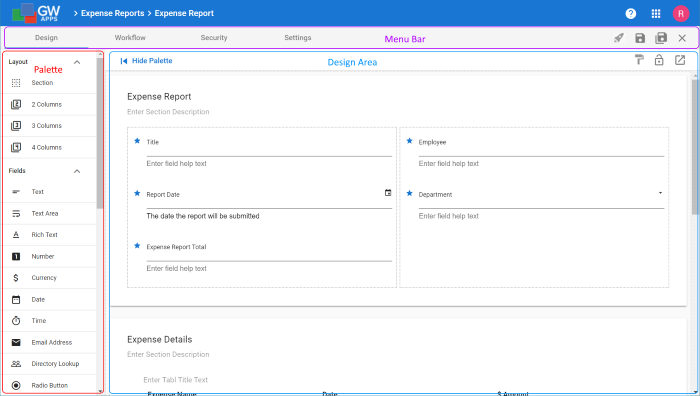 |
| Palette | The Palette is a list of things that can be added to the Design Area. For example: If you are designing a form it will be fields types and layout columns, if you are working on a page it will be charting widgets and the like, and if you are editing an email template or view it will be a list of the fields on the form you are working with. |
| Design Area | This is where the form, view, email template, page or whatever is displayed so you can work on it. |
| Menu Bar | For forms and views there are too many possible settings and features to fit them all on one page, so the menu bar has tabs that allow you to access these additional pages of settings. It also has the save and close icons. |
Next Steps
Continue with the following introductory articles:
- GW Apps Key Concepts
- Applications Dashboard
- Application Designer
- Views Dashboard & Creating Views
- Where to Find Help
For guided application-building examples, continue to Beginner Tutorials.
 English
 Spanish